

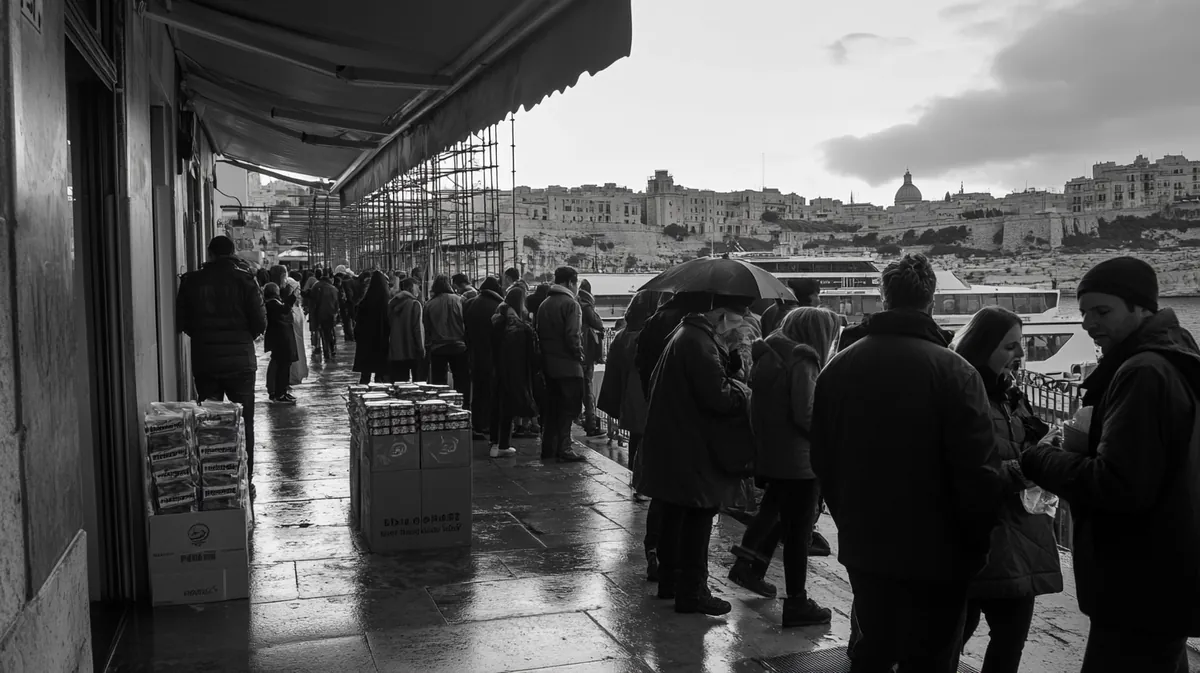
VALLETTA — At 08:03 on a damp Thursday morning a government press release described a culinary crisis in calm, bureaucratic prose: “To preserve national heritage and ensure the consistent textural integrity of savoury pastries, the Ministry of Heritage will implement the Pastizzi Standardisation Initiative (PSI).” By 08:27 the queue outside Tumas’ pastizzerija on Triq il-Kbira snaked past three scaffolds, a hedgehog of umbrellas, and a small temporary shrine to flaky geometry made of used baking paper.
For a country used to debating whether a festa tower is ‘on-brand’, the PSI landed like a misplaced cannon: adults arguing about lamination grades in front of school gates; teenagers attempting to vlog the ‘flake count’; grandparents hiding pastizzi in their ħobż biż-żejt lidded tins as if the island had suddenly converted to a pastizzi-based economy. “Uwejja, mela,” said one onlooker, wiping hands on a pocket of his shirt, “it is not just food any more. It is identity, iva.”
The Directive, the DIN, and the Degree of Flake
Documents obtained under a Freedom of Information request — and a WhatsApp forward from someone called Zaren — show the PSI is astonishingly granular. There is a nine-point “flake index” (FI), a bureaucratic diagram comparing pastizzi lamination to local limestone stratification, and an annex that recommends an ISO-style certification: Pastizzi Certified (PC). Ministry officials, via a curt spokesperson named Pawlu, insisted the scheme is meant “to protect heritage,” while the leaked memo suggests another motive: the national statistic that pastizzi consumption correlates with voter turnout in marginal wards.
Small pastizzeriji were told to measure flake with provided calipers and a paper chart; larger firms received a metallic “flake gauge” labelled in Maltese and English. Failure to meet minimum FI scores would trigger a temporary suspension, a fine, and — the most controversial clause — mandatory remedial training at the National Centre for Pastry Consistency in Mosta, where trainees are reported to practice lamination on antique festa banners.
Markets, Ferries, and the New Currency
In Gozo the PSI produced immediate operational problems. The Gozo Channel Authority announced a trial of a “pastizzi lane” on the ferry approach — ostensibly to streamline foot traffic but in practice creating a crush of folding chairs, crates of fresh pastizzi, and at least one argument about whether ricotta counts as an “acceptable curd standard.” Marija, a Gozo ferry barista who has worked three summers and two oil spills, said the bar became a triage centre for flaky trauma: “People come in shaking, they trade pastizzi like money. I had a man try to give me three pastizzi for a cup of coffee and his dignity. I had to refuse his dignity."
"People come in shaking, they trade pastizzi like money. I had a man try to give me three pastizzi for a cup of coffee and his dignity.”
On the main road through Zebbug, traffic wardens began issuing fines not for illegal parking but for “improper pastizzi display”: leaving boxes on car bonnets, or creating a cone of crumbs that impeded a bus’s right of way. Karmenu, a traffic warden who has been known to write parking tickets with the same hand he uses to sign birthday cards, explained the logic gravely: “If you obstruct traffic with your pastizzi, you obstruct the life of the nation.”
The Construction Angle Nobody Signed Up For
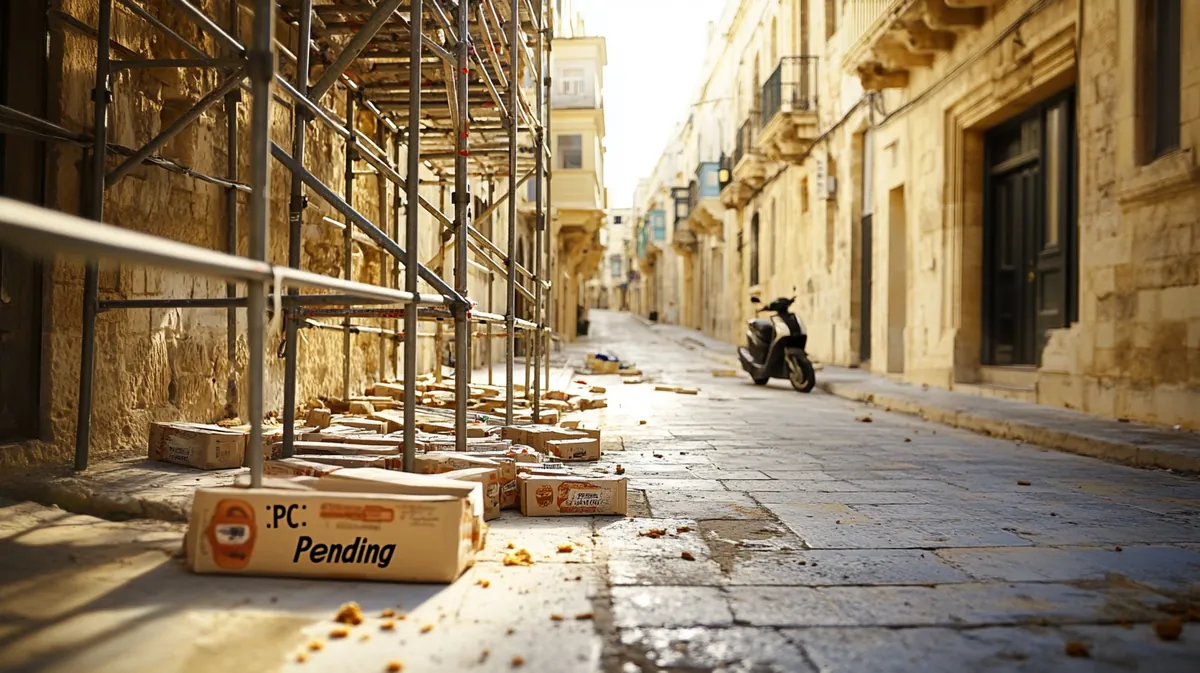
Where the story inescapably turned from culinary to structural was in Sliema, near an ongoing apartment site. Workers there, under pressure to keep the project on schedule and the union happy, began using surplus pastizzi as packing material between rebar — an improvisation born from a misread ministerial guidance note that said “use flaky fillers where necessary.” The scaffolders assured supervisors the pastizzi would dry and compact; an engineer with a suspiciously calm moustache warned of long-term crustal instability. Two weeks later a minor collapse sent a pantheon of small flutes and fag ends tumbling into a skip, along with a crate of unopened pastizzi labelled “PC: Pending”.
Construction companies denied any official endorsement of pastry as building material. The Ministry insisted on a full technical review and a press conference. A union representative asked only that future directives be printed on waterproof paper because “pastizzi weather is a thing.”
Local markets adapted in ways that read like urban folklore. In Mdina, a private club of retirees began staging clandestine “flake salons” where specimens from across the islands were judged on mouthfeel and nostalgia; in Marsaxlokk fisherman were rumored to be glazing their catch with leftover pastry oil to improve shelf appeal; in Valletta a council proposed amending parking permits to allow a single pastizz box per household in short-stay bays, citing “cultural preservation.” Across social media, influencers produced tutorials on how to smuggle pastizzi through festa cordons without damaging the lamination.
”If you obstruct traffic with your pastizzi, you obstruct the life of the nation.”
The backlash arrived from unexpected quarters. An association of immigrants who supply fresh ricotta and matita to local bakers published an open letter protesting that standardisation risks homogenising recipes passed down through generations of fenkati and sea-farers: “Our pastizzi were made by people who knew the sea and the cave and the correct salt. A table cannot capture that.” Meanwhile, a well-dressed think tank produced a 120-page policy paper suggesting the PSI could be paired with a tourism levy if the flavour profile is sufficiently “authentic” — a recommendation that triggered one of the more surreal episodes: a debate in a council room about whether tourists should be admitted to watch pastizzi being lamination-certified as part of a VIP cultural experience.
At the national bakery in Rabat, Tumas, a pastizzai with flour in his ears and a cipher tattoo of a pastry on his forearm, summed up the current mood: “We are not against standards, but when they ask me to report flake loss by postcode and to submit quarterly crumb samples, I ask what next? Will they regulate my sighs? My grandmother’s noises when she folds the pastry?” He paused, then added in a whisper meant for any leaking microphones: “Also, I will not give up my pastizzi for a parking permit.”
The PSI rollout has been delayed for procedural reasons and for reasons less easily listed on paper: civic outcry, two small scaffolding incidents, one very public argument on a Gozo ferry, and a viral video of a man attempting to pay for a train ticket with a pastizz that had gone cold. In parliamentary corridors, ministers speak of pilot projects, of committees, of the need to “get this right for the children.” Outside, the queues persist, people clutching yesterday’s flaky reliquaries like charms against the weather and the future.
At press time, a local festa committee offered to mediate, proposing a compromise: a national flake festival judged by retired canonesses, parking wardens, and a panel of anonymous influencers, with proceeds to fund the National Centre for Pastry Consistency — provided, they added with characteristic Maltese frankness, that the first prize is a year’s supply of pastizzi and a guaranteed ferry lane. Uwejja, the nation murmured, and then lined up again.