

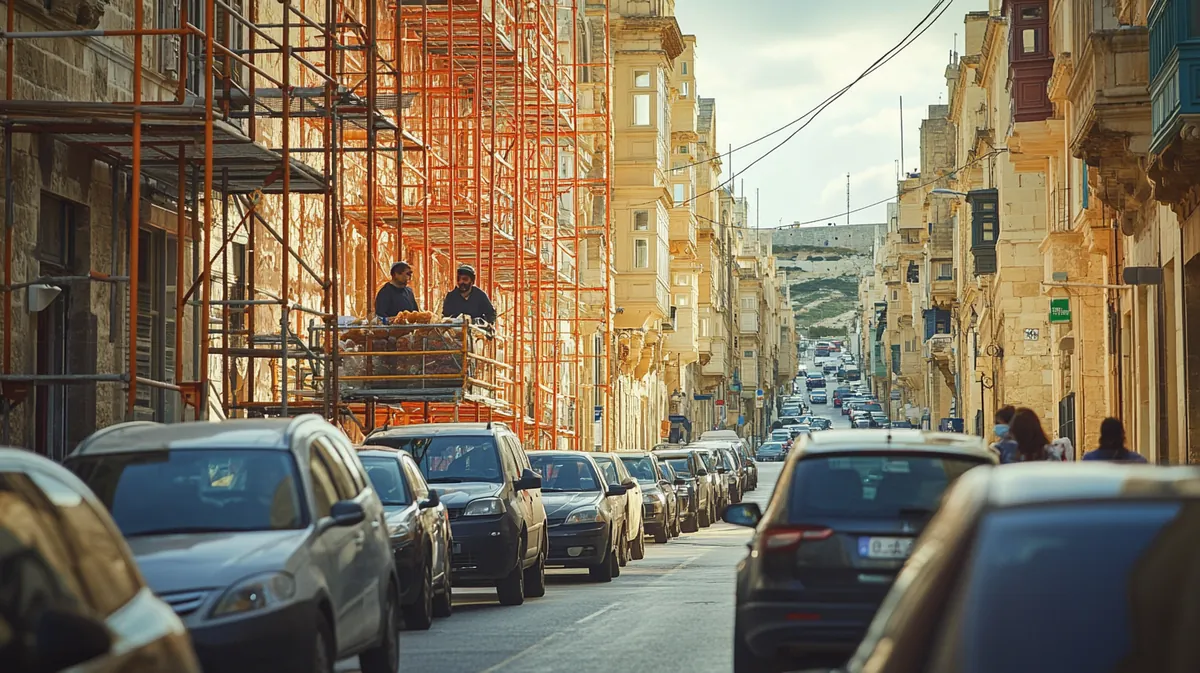
VALLETTA — Following Tuesday’s minor-but-very-noteworthy collapse of a stretch of scaffolding on Triq il-Kbira in Msida — which temporarily slowed traffic more effectively than any festa firework ever could — the Planning Authority issued a recommendation today that Malta’s towns be given a ‘considered, stratified look’ by installing more scaffolding, scaffolding, and, where appropriate, scaffolding with hanging laundry.
Officials, who spent the morning holding a solemn photo-op behind a cluster of safety cones and an upside-down traffic sign, said the move is intended to celebrate the country’s unique way of doing things: planning by delay, construction by guesswork and the national pastime of manoeuvring a Smart car through a gap that technically shouldn’t exist.
Officials Respond
”We have observed that scaffolding has become an integral component of the Maltese urban palette,” said Karmenu Xerri, deputy director of the Authority, while pointing to a map where every colour was replaced with a bright orange scaffolding icon. “If we accept scaffolding as an architectural element, we can then begin to manage it — and, crucially, charge for its aesthetic value when developers come to us asking for permission to change windows. Uwejja, there is money here. Mela, there is always money somewhere.”
Local businesses welcomed the idea on the condition that the new scaffolding include built-in platforms for selling pastizzi and gbejniet. Joey from the pastizzerija outside the collapsed site proposed a prototype: a cantilevered pastizz stall that doubles as a temporary balcony for tourists taking staged photos of ‘authentic Maltese renovation.‘
The Public Reaction
Residents had mixed feelings. Marija from Msida suggested scaffolding be colour-coded according to the type of delay — red for legal appeals, blue for funding issues, green for ‘waiting on the Gozo ferry schedule.’ Tumas, a pensioner who has navigated every Gozo ferry strike since 1997, proposed a new civic ritual: a blessing of the scaffolds at festa time, followed by a polite fenkata and a quietly furious conversation about parking wardens.
Critics argued that declaring scaffolding heritage risks normalising hazard. A local engineer, who asked not to be named because he is currently constructing his opinion on top of a half-finished staircase, pointed out that there is a difference between “historic character” and “a suspended platform from which pigeons can file complaints.” The Planning Authority replied by issuing guidance on how to hang string lights from scaffolding in ways that improve Instagram engagement.
The Fallout
In an unsurprising twist, the scaffolding industry’s stocks — largely imaginary until today — spiked on the back of speculative offers: a proposal to brand some scaffolds with the names of foreign investors, and a rival scheme to build temporary pop-up cafés on cantilevered walkways, complete with espresso machines and chargers for phones that will inevitably die in traffic on Triq il-Kbira.
Meanwhile, the Gozo ferry authority announced a consultation on whether the ferry should be fitted with modular scaffolding to facilitate ‘seamless transfer of under-construction mood’ between islands. Pawlu, who had to leave his car overnight on the Tal-Ħandaq roundabout during Tuesday’s chaos, said he was mostly concerned about whether the scaffolding would block his view of the ferry horns, which are the only thing more reliable than Maltese roadworks.
”If the scaffolding helps tourists finally understand that we are always building towards something, even if we don’t know what it is, then perhaps it will be a unifying project.”
What Happens Next
The Authority announced an ambitious pilot: a three-month programme to outfit Valletta, Sliema and Mdina with ‘managed under-construction zones’ to evaluate public sentiment, the sale of pastizzi from the second tier, and whether temporary scaffolding boosts local morale more than immediate pothole repair. Opponents vowed to sue, or at least to change their Facebook profile pictures to black and white.
For now, the city moves forward (slowly) under a network of poles and planks. Somewhere between a traffic jam on Triq il-Kbira, a pastizz in a paper bag and a Gozo ferry horn, Maltese citizens will learn to live with a skyline that is perpetually mid-thought — like the sort of person who pauses, says “I was just about to…” and then never finishes the sentence.
At press time, a self-appointed committee had convened on the scaffolding to vote on a name for the project; results were pending because one member insisted on delaying until everyone agreed on the proper pronunciation of “għajn.”