

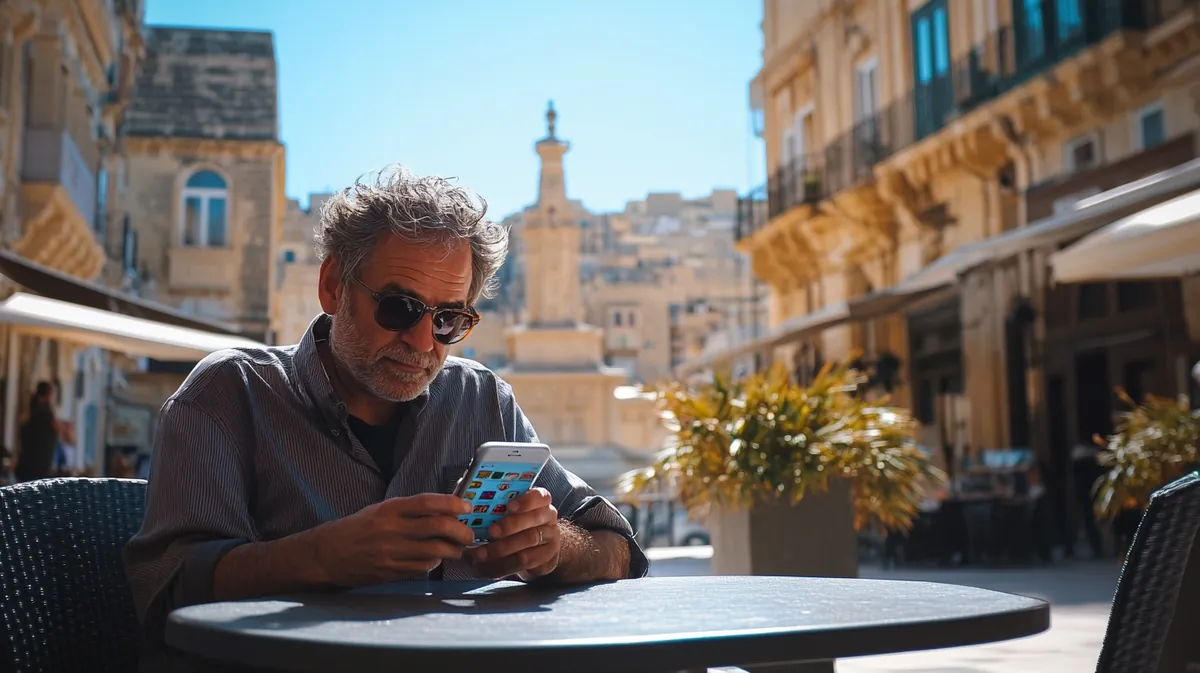
VALLETTA — Karmenu Borg, 52, arrived in Valletta at 8:47am on Monday with a simple plan: park, buy bread, leave. He found a spot at 9:32am. He is still sitting in the café opposite it now, on his fourth coffee, watching the space through his sunglasses like a hawk guarding a nest.
”I can’t leave,” he said, not taking his eyes off a white Peugeot two spaces down that he described as “suspicious.” “Do you know what I went through to get that spot? Three roundabouts. Two dead ends. One reversing incident involving a dog. Uwejja, I’m not throwing that away for a loaf of bread.”
The mathematics of Maltese parking
Karmenu’s situation is not unusual. Transport researchers at the University of Valletta estimate that the average Maltese driver spends 38 minutes finding parking and then between 45 minutes and four hours guarding it psychologically from a nearby establishment. The phenomenon, known locally as “Postjunk Stress,” affects an estimated 1 in 3 drivers on any given weekday morning.
”The spot becomes more valuable the longer you’ve waited for it. By the time you’ve circled Valletta three times, that parking space is basically real estate. You don’t just walk away from real estate.”
Karmenu has been monitoring his spot remotely for four hours. He has ordered six coffees, two pastizzi and a glass of water he did not want. He has also befriended the waiter, whose name is Leli, and made him promise to call if anyone parks within two spaces of his car.
A man, a phone, a spot
By midday, Karmenu had developed a full intelligence operation. He moved his chair three inches to improve his sightline. He downloaded a parking app that doesn’t cover Valletta but, he said, “gives moral support.” He sent a photo of his car to his wife with the caption: “This is where I am. This is where I will be."
"I was going to go to the bakery. Then I thought: what if someone takes the spot while I’m inside? The bakery has no windows on that side. Mela, that’s a risk I can’t take.”
His wife sent back a voice note saying the bread was not that important. Karmenu listened to it twice and replied: “You don’t understand.”
When asked if he had considered simply leaving and finding another spot if needed, Karmenu looked at the interviewer for a long moment. “Find another spot,” he repeated slowly, as if hearing the phrase for the first time. “In Valletta. On a Monday.” He then turned back to the window.
At press time, a street cleaner’s van had briefly paused near Karmenu’s car. He was on his feet before it stopped. The van moved on. Karmenu sat back down. Leli brought him another coffee without being asked. Neither of them said anything. They both understood.