

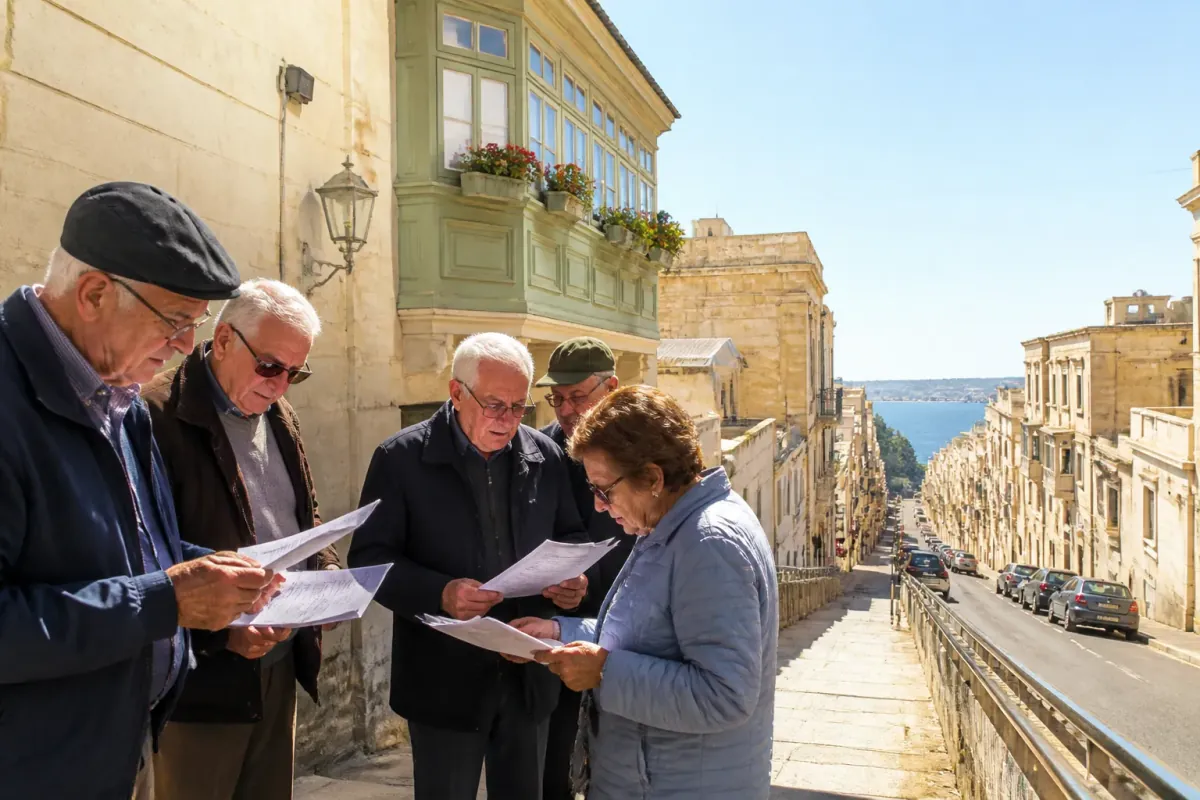
VALLETTA — In a move that has left many scratching their heads, the Maltese government announced that all official documents must now be written entirely in dialect. The decision, deemed ‘absolutely necessary’ by officials, has prompted a nationwide shortage of translators and left confused pensioners attempting to navigate the chaos of what they call ‘Għawdex-ese.’
”I just wanted to know if my pension got increased!” complained 78-year-old Maria, holding a document heavy with local slang that resembled a foreign language. “They wrote ‘jekk int biex tqum filgħodu, aċċerta ruħek li l-bragoli ġodda jgħaddu’ – what even is that?”
The new policy has sparked a wave of confusion across the islands. According to reports, senior citizens are gathering in coffee shops, frantically trying to decipher what was once straightforward. Residents are overheard requesting translations over pastizzi and ħobż biż-żejt. “I thought I was just seeing double; turns out my letters are in Għawdex-ese!” exclaimed Tumas, a retired factory worker.
”My brother was so lost, he thought his driver’s license had expired because it mentioned ‘buss il-ħafra’!”
In response to the growing chaos, the government said they will be organizing free dialect workshops to help citizens adjust. However, the classes have already reached full capacity, with waiting lists forming faster than a queue for the Gozo ferry.
Local Dialect Experts Weigh In
Experts warn that the lack of standardization in dialect could result in catastrophic misunderstandings. “If we can’t agree whether to say ‘mela’ or ‘mela’ depending on the locality, we might as well be in Għawdex for good!” said linguist Karmenu in a talk at the local university.
At press time, pensioners were reported trading dialect lessons for spare change, while the Planning Authority is considering a proposal to build an